Emotional Stress Release: how to manage stress with a touch on the forehead
An applied kinesiology technique you can do yourself in 5 minutes – and why it works neurologically
The stress that remains in the body
We have all experienced that feeling: a moment of intense tension-an argument, bad news, a situation that overwhelms us-and even hours later the body is still “on.” Our head is elsewhere, our muscles are tense, we sleep poorly.
What happens in these moments is not only psychological. It is physiological. The nervous system has been activated in fight-or-flight mode and has not yet found the signal to deactivate itself.
Emotional Stress Release – ESR – is a simple technique, taught in many kinesiology modalities, that helps the nervous system get out of that state. And it is done with a minimal gesture: holding a hand resting on the forehead.
The neurological basis
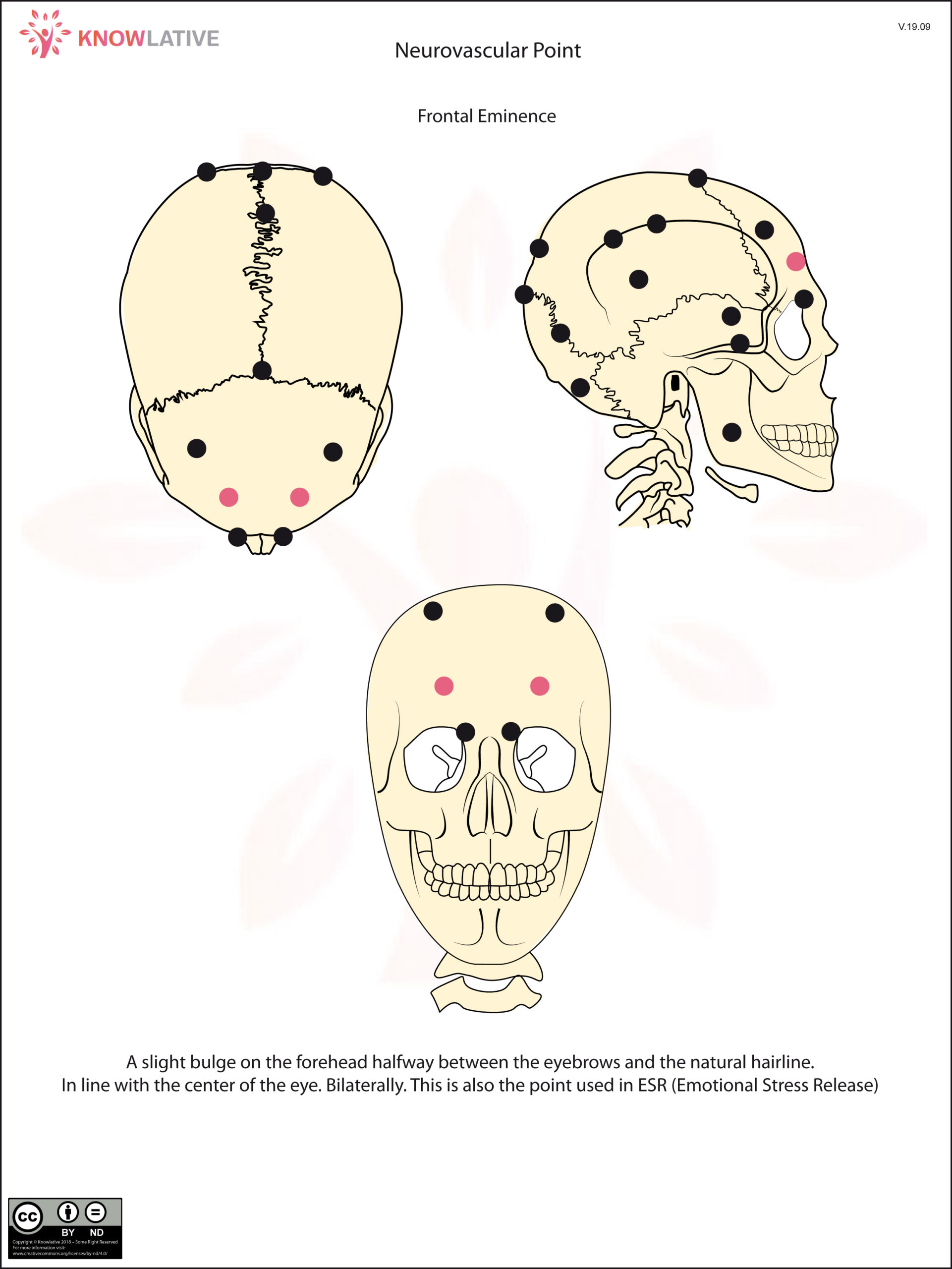
The points used in ESR are located on the frontal prominences-the slight bony protrusions on the forehead, approximately halfway between the eyebrows and the hairline, in line with the eye centers. In kinesiology these points are known as neuro-vascular points or frontal Bennett points, and are functionally associated with the Stomach meridian.
The neurological theory is this: a light touch on these areas helps redistribute blood flow to the frontal cortex–the part of the brain responsible for rational thinking, planning, and evaluation–and moves it away from areas of the brain involved in alarm and panic responses, such as the amygdala.
Basically: you help the brain switch from reactive mode to reflective mode. The stress response is reduced. The body can begin to relax.
How is it done
The technique is very simple. You can do it alone, sitting or lying down, at any time.
Put the fingers of both hands on the frontal prominences-the slightly protruding areas on the forehead, above the eyebrows, in line with the pupils. Use a very light touch, almost a caress. Feel the pressure of the contact without pressing.
As you hold your hands in this position, think about the situation that is creating the stress. Let the thoughts and feelings emerge naturally-don’t try to block or analyze them. Stay with the thought and the contact. Imagine you are at the movie theater and watching the film of the stressful episode on the screen.
Hold for as long as necessary – 30 seconds to 5-7 minutes, depending on how deep the stress is. Often you will hear one or more spontaneous deep sighs: this is a sign that the nervous system is beginning to decompress. At that point take a deep conscious breath and remove your hands.
When it is useful
ESR is useful at all those times when the nervous system is over-activated and you cannot mentally “disconnect.” Before a stressful situation – an exam, a difficult conversation, an important appointment. After an episode of intense tension. Before sleep when the mind keeps spinning.
It is also useful to work on past stressful memories-episodes that continue to “weigh” emotionally even after time has passed. If the memory is complex and involves several episodes, it may be useful to work on each episode separately.
For example, if the memory on which you want to use this technique is too stressful, such as a long period of illness or stress that has lingered over time, divide the whole “movie” into episodes as if it were a Netflix series. By doing this you can use the technique on one episode at a time, perhaps on different days, and make the process easier and more effective.
An integration with Systemic Orthopedics.
In my clinical practice, ESR is one of the tools I use when it becomes apparent that the emotional component is contributing to the maintenance of physical pain. As in the case of the girl with the neck stuck after the vacation fight — working on the unresolved stressful episode was a key part of the treatment.
It’s not magic. It is the physiology of the nervous system: unprocessed stress maintains a state of muscle activation that can contribute to chronic pain, contractures, and difficulty in recovery. Reducing that state of activation is part of the treatment, not an add-on.
ESR is a tool you can use on your own. But if your physical pain has a significant emotional component, it may be worth exploring this connection more fully with a professional.
Do you want to understand the cause of your pain?
In the assessment with Systemic Orthopedics, the emotional component is explored along with the postural, metabolic, and nutritional components. Book an evaluation-even online-to begin to see the full picture.